
Since 2026, seaweed-based bioplastic packaging has been gaining significant traction globally. From Swiss startup Noriware‘s biodegradable seaweed films to Chinese companies’ seaweed polysaccharide edible films, this marine biomass resource is emerging as a promising direction for the packaging industry‘s green transformation.
According to industry data, over 400 million tons of plastic waste are generated globally each year, with only 14% of plastic packaging being recycled. In this context, seaweed-based packaging materials are attracting widespread attention due to their renewable feedstock, natural biodegradability, and no competition for land resources.
I. Why Is Seaweed-Based Packaging Attracting Attention?
Seaweed grows rapidly in coastal waters – up to 1 meter per day – without requiring freshwater, fertilizers, or land. Rich in polysaccharides such as carrageenan, agar, and sodium alginate, seaweed can be processed into flexible films.
Key Performance Advantages:
- Rapid degradation: Seaweed-based films completely decompose into water and CO₂ within 12 weeks under industrial composting conditions, with a significantly shorter degradation cycle in natural environments compared to conventional plastics
- Performance approaching conventional plastics: Laboratory-verified tensile strength reaches 35-45 MPa, outperforming traditional LDPE films (10-20 MPa)
- Compatible with existing production lines: Requires minimal adjustments for production on standard plastic processing equipment
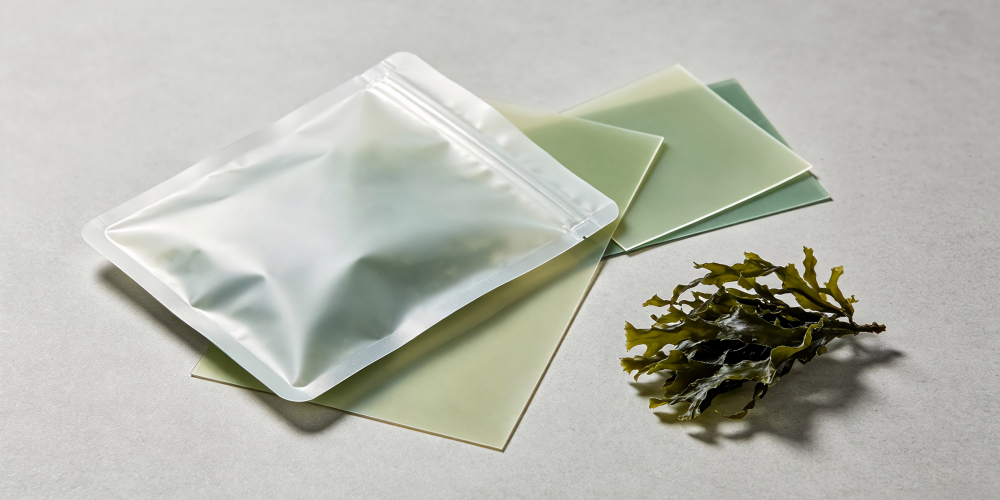
II. Industrialization Progress Accelerates
Internationally, Swiss company Noriware has developed home-compostable seaweed-based films, securing multiple rounds of funding from Innosuisse and expanding partnerships with European producers. Several European food brands have begun piloting seaweed-based packaging as an alternative to conventional plastics.
In China, local manufacturers have overcome traditional challenges such as water solubility and insufficient strength, launching high-performance films using seaweed polysaccharides as the core raw material. These products achieve tensile strength of 23±3 N/15mm and degrade naturally within 30-90 days in home or natural environments, and have obtained DIN 100% home compostability certification.
III. Current Challenges and Industry Outlook
Large-scale commercialization of seaweed-based packaging still faces three key challenges:
- Limited raw material supply: Global refined alginate production is only about 50,000 tons annually, insufficient to support large-scale packaging production
- Moisture resistance to be improved: The mechanical properties of seaweed films degrade significantly under high temperature and humidity conditions
- Cost premium: Current seaweed-based plastic costs roughly 2-3 times that of conventional plastics
Industry consensus suggests these bottlenecks will gradually be overcome in the next 2-3 years as extraction technologies mature and production scales up, with costs projected to decline by 30%-40%.
IV. Implications for the Packaging Industry
The rise of seaweed-based packaging reflects two broader trends in the global packaging industry‘s green transformation:
- Diversification of raw material sources: Expanding from petroleum-based to bio-based and marine-based materials
- Clearer certification standards: EN13432, BPI, and other certification systems becoming a “hard requirement” for green packaging
For brands and packaging buyers exporting to the EU, regardless of the material ultimately chosen, recognized international certification remains a prerequisite for entering overseas markets. Our company will continue to monitor technological advancements in seaweed-based biomaterials, actively exploring more sustainable packaging solutions while meeting customer requirements for delivery lead times, quality standards, and cost control.