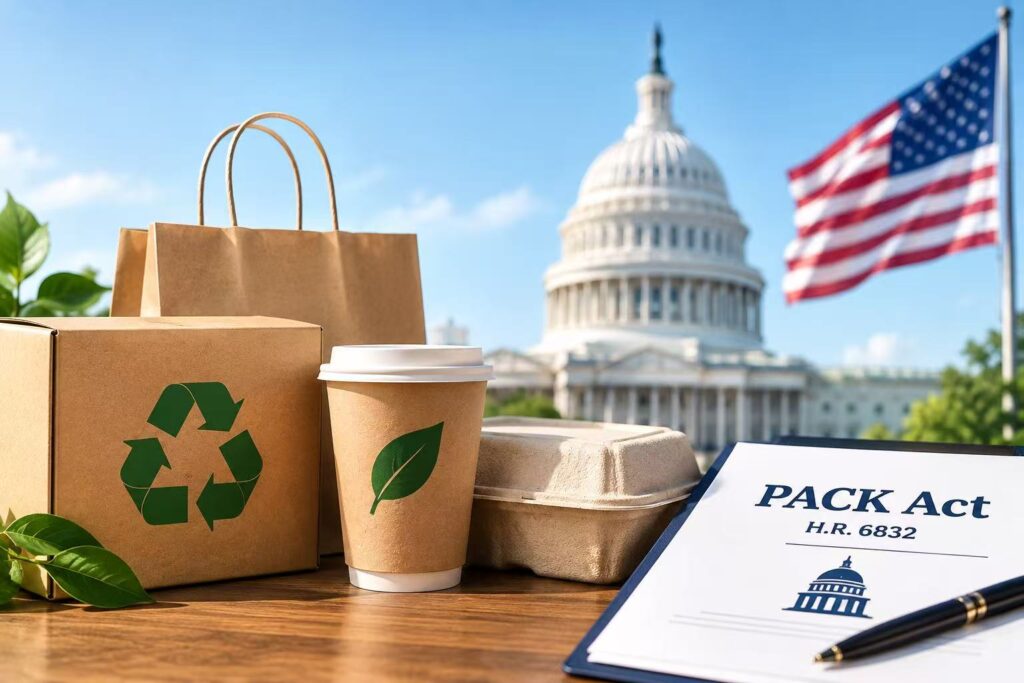
On September 1, 2026, the United States Packaging and Claims Knowledge Act (PACK Act, H.R. 6832) successfully passed the review by the House Energy and Commerce Subcommittee and entered the full committee review stage, marking a disruptive upgrade in the supervision of environmental labeling for packaging in the United States. The Act amends the Federal Trade Commission Act, replacing the fragmented and inconsistent state-level packaging regulations with a unified national compliance framework. It fully standardizes three major categories of environmental claims on consumer product packaging: recyclable, compostable, and reusable.
The PACK Act establishes a core regulatory principle of “voluntary claims, mandatory certification”. Enterprises may voluntarily choose to display environmental attributes on their packaging. However, any public environmental claims regarding recyclability, compostability, or reusability must be supported by valid certification documents issued by authoritative third-party institutions. Packaging without qualified certification is prohibited from using the official tracking arrow recycling symbol and will be banned from circulation in the U.S. market.
As a key initiative to standardize the U.S. packaging industry, the PACK Act has gained strong support from authoritative industry organizations including the U.S. Chamber of Commerce, the National Association of Manufacturers, and the Consumer Brands Association, as well as leading multinational corporations such as PepsiCo, Nestlé, General Mills, and Kraft Heinz. With a clear implementation timeline and wide industry recognition, it will soon become the core market access standard for imported packaging in the United States.
For foreign trade enterprises, packaging buyers, and brand owners focusing on the U.S. market, the legislative upgrade has completely reshaped industry rules. Environmental packaging labels are no longer mere marketing selling points, but rigid compliance requirements that are fully documented, traceable, and verifiable. In parallel with the EU’s PPWR regulations which have strengthened third-party certification rules, the two major global consumer markets have formed coordinated regulatory oversight. Packaging compliance certification has evolved from an optional advantage into a mandatory market access asset. Products without valid certifications will face risks including customs clearance delays, market sales bans, and regulatory penalties.
In response to the increasingly stringent packaging compliance requirements across Europe and the United States, aritpack has proactively built a comprehensive global certification system. All our products hold authoritative third-party international certifications, including EU EN 13432, U.S. BPI, and OK Compost. All qualifications are issued by officially accredited third-party organizations, ensuring authenticity, validity, and global applicability.
Tailored for U.S. export demands, aritpack’s BPI certification fully meets the third-party verification requirements specified by the U.S. PACK Act. It provides legitimate and effective compliance proof for customers making “compostable” environmental claims on packaging products, helping overseas clients clear customs smoothly, avoid regulatory risks, and fully comply with the latest U.S. packaging supervision standards.
The PACK Act still requires full committee voting, House floor review, and Senate deliberation for final enactment, leaving a transition period for market adaptation. Nevertheless, the regulatory trend is unequivocal: global supervision over packaging environmental claims is moving toward unified standards, mandatory certification, and full traceability and verification.
Moving forward, aritpack will continuously monitor updates to European and American packaging regulations, adhere to high-standard compliant production, and provide one-stop compliant packaging solutions for global B2B buyers with complete international certifications and stable product quality. We help clients adapt to the latest overseas market rules effortlessly and consolidate their competitiveness in global markets.